


Lucca AI agent for your HR help desk.
PTO requests, policy questions, pay queries, and onboarding workflows handled in Slack from live Lucca data. No developer. No portal. No HR ticket.
HR Teams of all sizes trusts Workativ AI to automate HR Operations & Support

Lucca AI stays inside the platform. Three things that leaves unsolved.

Lucca AI doesn't reach Slack or Teams
Lucca's own AI works inside the platform. Employees asking questions in Slack get nothing from it.

Lucca Office syncs calendars, not conversations
Slack and Teams show who's out and sync leave status. Employees can't ask questions or submit requests there.

New hire in Lucca still needs IT to act
Poplee records the hire. IT access, other app provisioning, and the day-1 checklist are still manual.
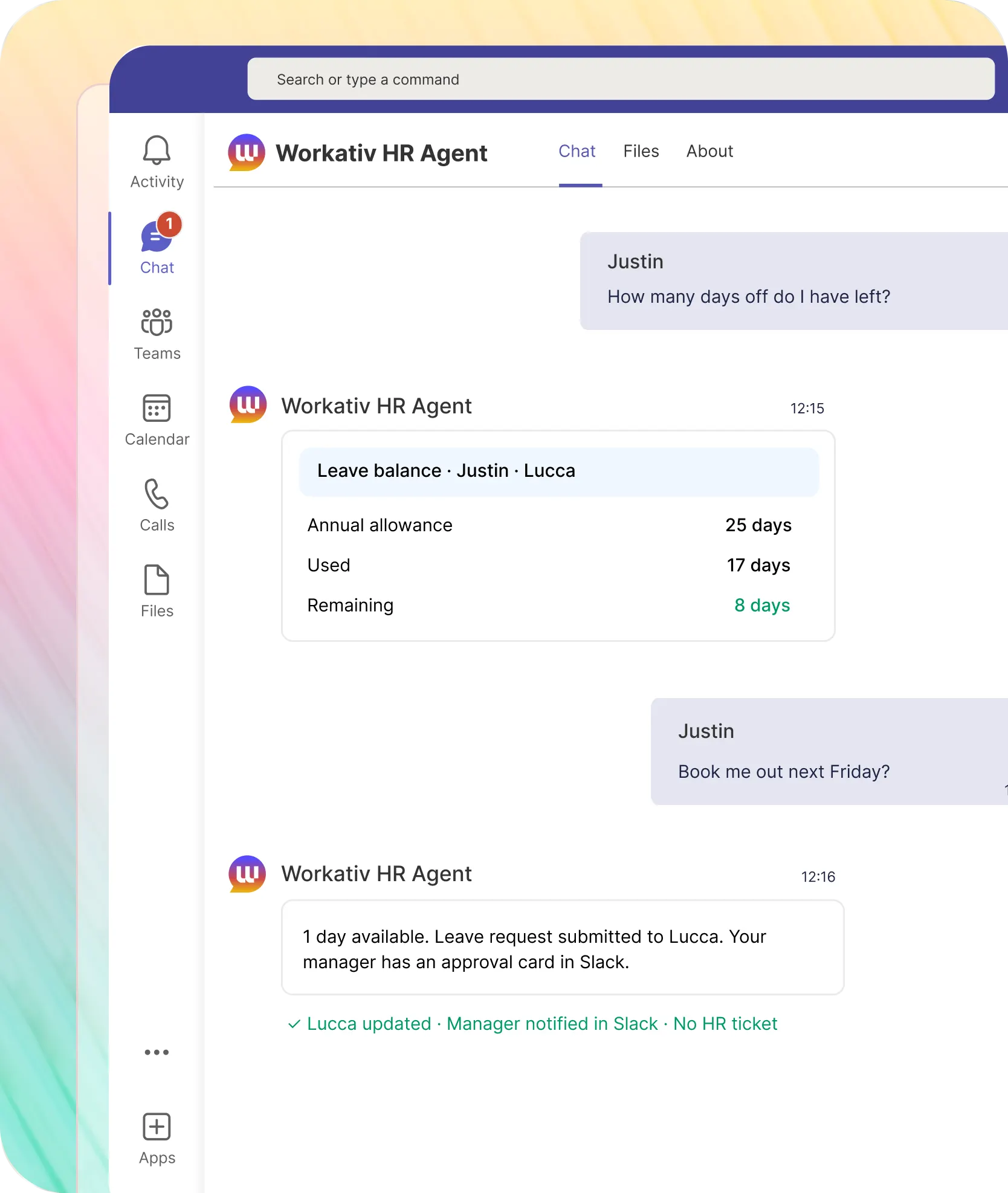
Every Lucca request resolved in Slack. No portal. No HR ticket.
Employee asks in Slack. Workativ reads from Lucca, takes the action, and confirms all in the same thread.
Leave balance from Lucca in seconds. Request submitted and approved all in Slack.

Live leave balance read from Lucca's Timmi Absences API
Leave request submitted through Lucca's Figgo approval workflow
Manager approves in Slack Lucca record updated on approvall
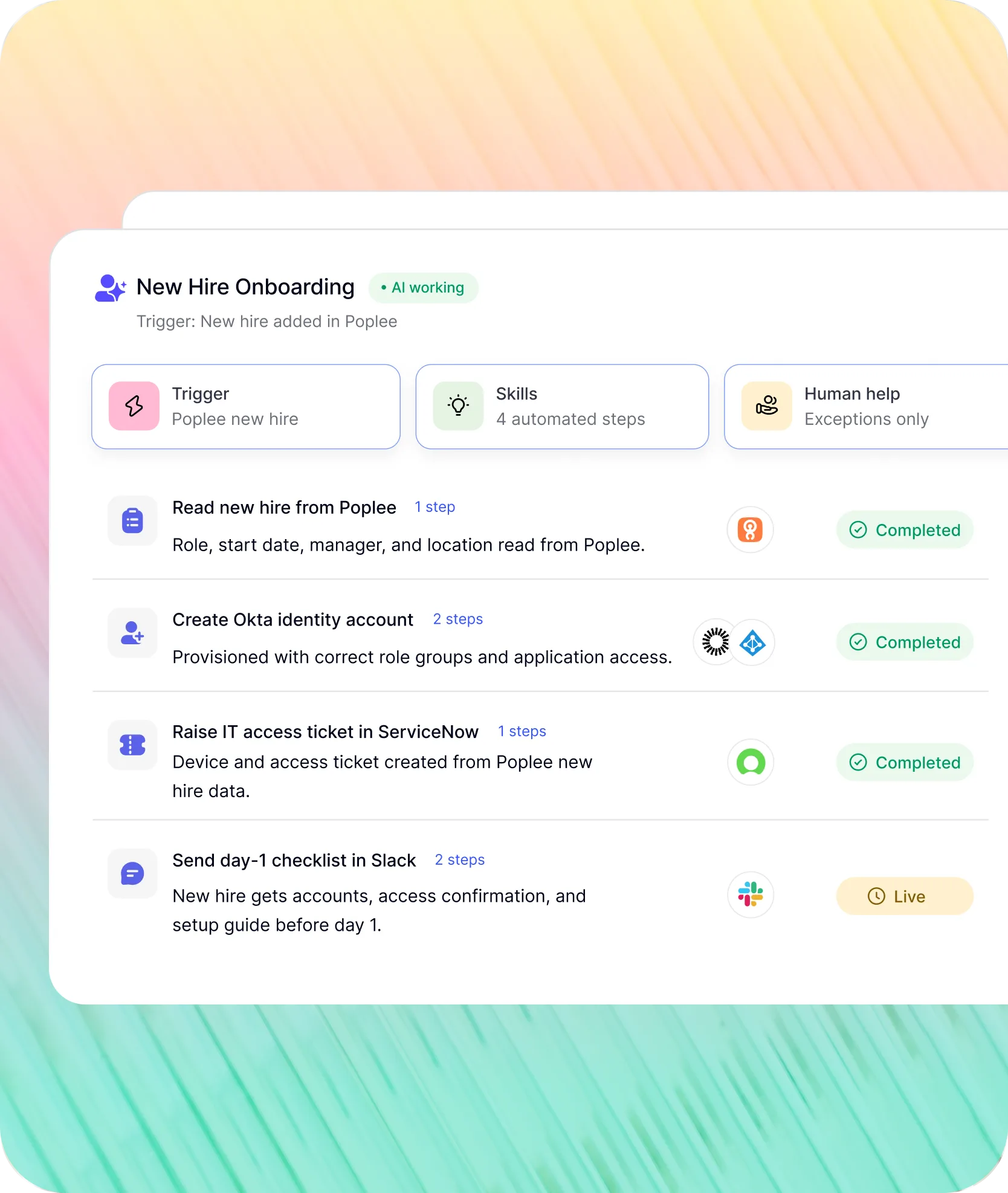
Lucca events trigger workflows across every connected system. No one coordinates manually.
Lucca fires the event. Workativ handles Okta, Azure AD, ServiceNow, and Slack. HR sets it up once.
New hire added in Poplee. Okta provisioned, IT ticket raised, day-1 checklist sent no HR step.
Triggered by new hire event in Lucca's Poplee module no manual kickoff
Okta profile set up with the correct role and group memberships
The checklist reaches the new hire in Slack before their first day begins
GoTo automated 80% of HR queries by connecting its HRIS to Workativ in Slack.
“ Our AI Bot Orion has become a critical enabler of employee self‑service. The quality of responses is fast, comprehensive, and highly reliable, allowing employees to find accurate answers without needing to escalate to HR or IT. What really sets Workativ apart is the visibility into question trends, resolution rates, and where AI is genuinely reducing operational workload. ”

Susan Treadway
Vice President, HR Operations

Connect Lucca to Slack in three steps. HR team does the setup.
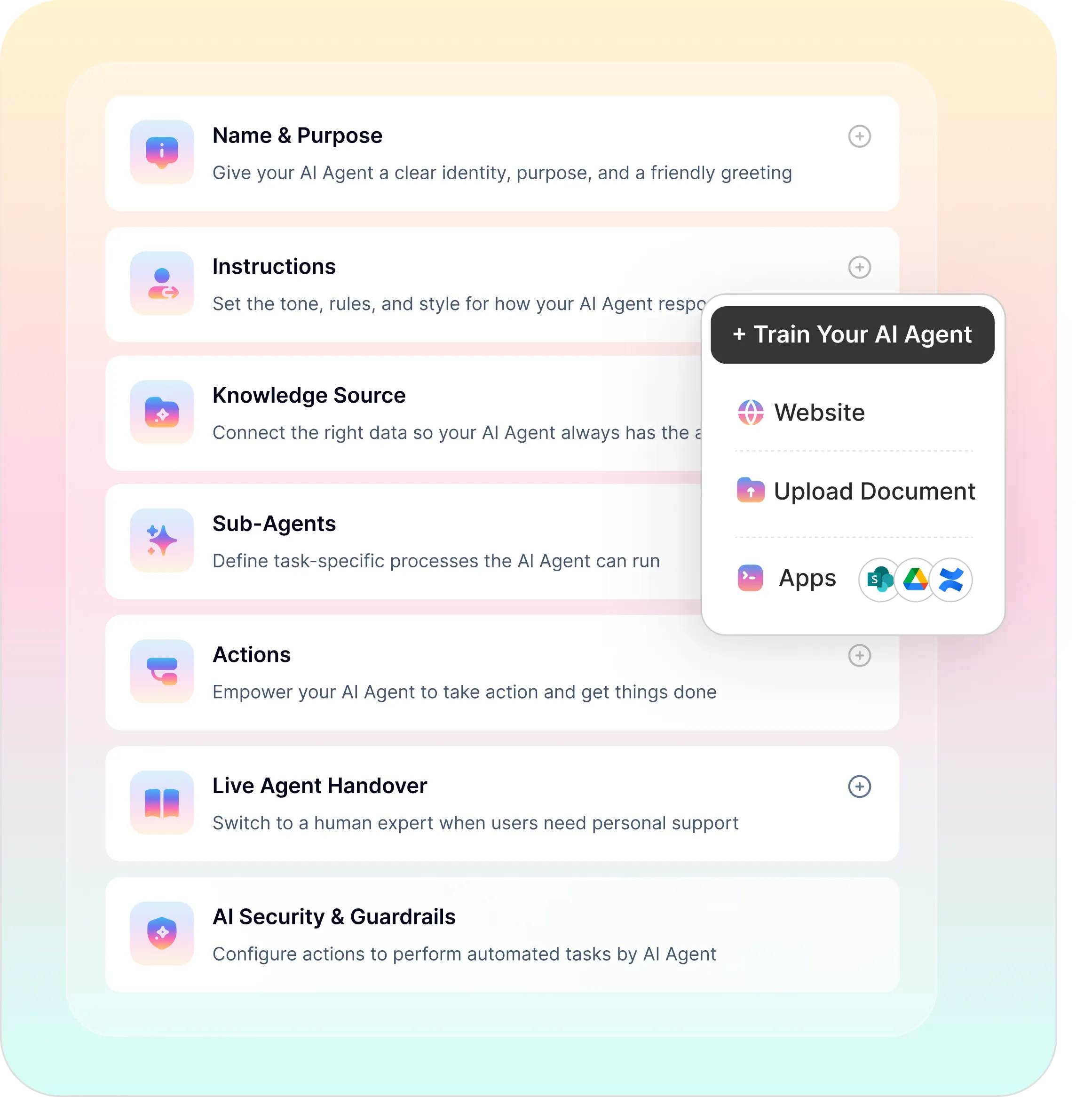
Built for HR teams without a developer. Lucca stays your system of record.
A no-code builder, agentic RAG, workflow automation, and security all without a separate implementation project.
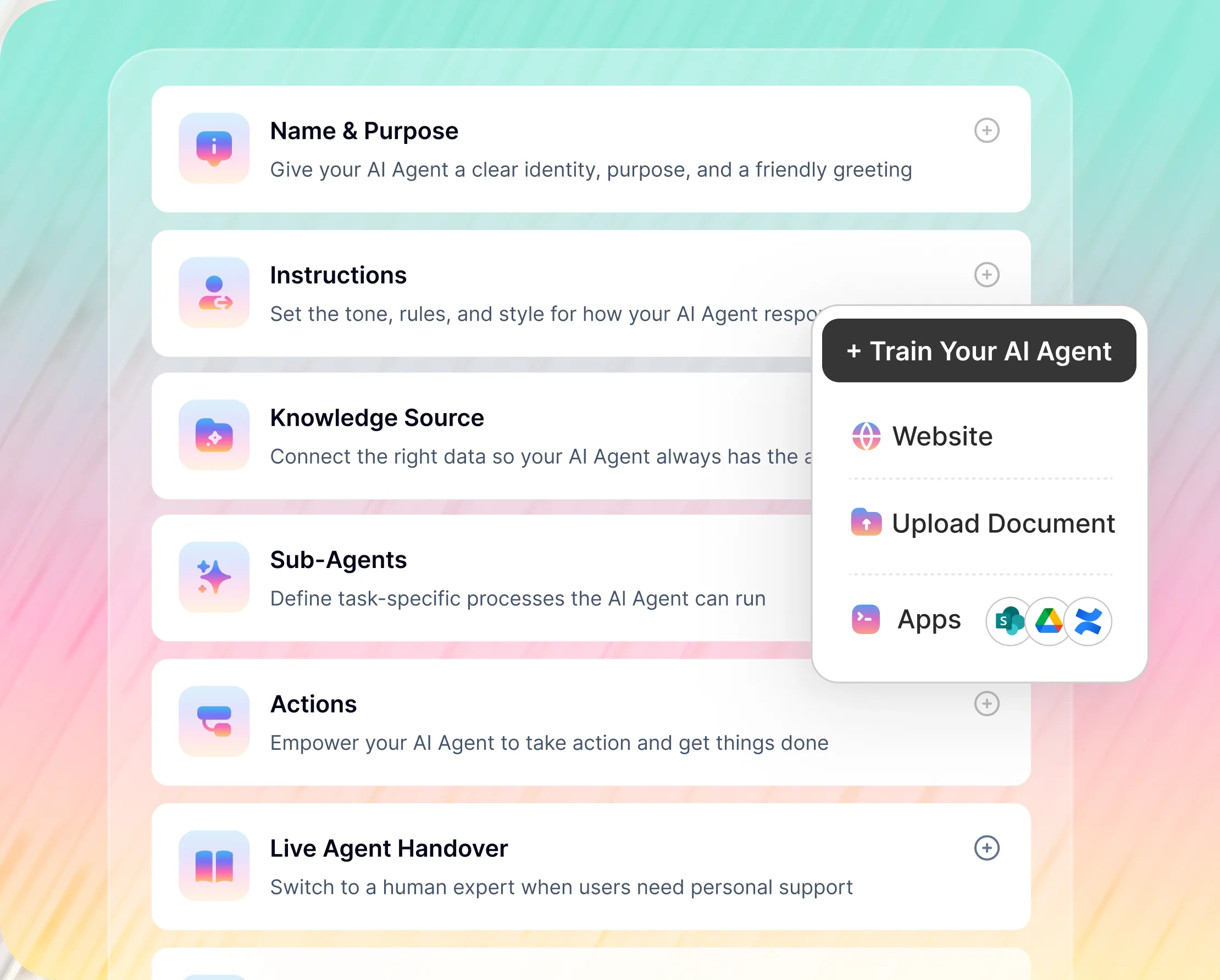
No-Code Lucca AI Agent Builder
Lucca leave, payslip, personal updates, and expenses all configured point-and-click
Hands off to a live agent the moment employees need a real HR conversation
Lucca module permissions set by HR, not an implementation consultant
Lucca AI works inside the platform. Here's where Workativ fits.
Lucca AI is an opt-in add-on for tasks inside Lucca itself. Workativ brings the same data into Slack and connects Lucca events to your full stack.
What matters to HR |  |  |
|---|---|---|
Where employees interact |  | Inside the Lucca platform |
Submits Leave requests | | In-platform task assistance only |
Updates employee records | | Depends on the specific in-platform task |
Cross-system automation | |  |
New hire onboarding trigger | | |
Policy Q&A with source citation | | Varies by configured task |

When Lucca AI is enough:Your team only needs help with specific in-platform tasks and doesn't need employees to act from Slack.
When to add Workativ:Employees ask in Slack and expect the action to happen not just an answer inside Lucca. New hires need Okta provisioned from Poplee. Terminations need Azure AD disabled the same day. Workativ and Lucca AI run alongside each other Lucca stays your system of record.
Lucca plus every system your employees and HR team work across.
One Lucca AI agent in Slack leave, pay, expenses, and onboarding workflows coordinated across Lucca and every connected system.


%20--%3e%3csvg%20version='1.1'%20id='Layer_1'%20xmlns='http://www.w3.org/2000/svg'%20xmlns:xlink='http://www.w3.org/1999/xlink'%20x='0px'%20y='0px'%20viewBox='0%200%20512%20512'%20style='enable-background:new%200%200%20512%20512;'%20xml:space='preserve'%3e%3cstyle%20type='text/css'%3e%20.st0{fill:%23F7F7F7;}%20.st1{fill:%2328E4C3;}%20.st2{fill:url(%23SVGID_1_);}%20.st3{fill:url(%23SVGID_2_);}%20%3c/style%3e%3ccircle%20class='st0'%20cx='256'%20cy='256'%20r='245.5'/%3e%3cg%3e%3cg%3e%3cpath%20class='st1'%20d='M304.7,405.6'/%3e%3c/g%3e%3c/g%3e%3cg%3e%3cg%3e%3cpath%20class='st1'%20d='M305.8,353'/%3e%3c/g%3e%3c/g%3e%3clinearGradient%20id='SVGID_1_'%20gradientUnits='userSpaceOnUse'%20x1='388.1461'%20y1='99.0534'%20x2='204.4846'%20y2='204.5899'%20gradientTransform='matrix(1%200%200%20-1%200%20514)'%3e%3cstop%20offset='0.18'%20style='stop-color:%230052CC'/%3e%3cstop%20offset='1'%20style='stop-color:%232684FF'/%3e%3c/linearGradient%3e%3cpath%20class='st2'%20d='M119.9,330.3c-3,4.9-6.4,10.7-9.3,15.3c-2.6,4.4-1.2,10,3.1,12.7l60.7,37.4c4.4,2.7,10.1,1.3,12.9-3%20c0,0,0.1-0.1,0.1-0.1c2.4-4.1,5.6-9.3,9-15c24-39.7,48.2-34.8,91.9-14l60.2,28.6c4.7,2.2,10.2,0.2,12.4-4.4c0-0.1,0.1-0.2,0.1-0.3%20l28.9-65.4c2-4.7,0-10.1-4.7-12.2c-12.7-6-38-17.9-60.7-28.9C242.6,241.2,173.1,243.7,119.9,330.3z'/%3e%3clinearGradient%20id='SVGID_2_'%20gradientUnits='userSpaceOnUse'%20x1='613.0198'%20y1='1773.9866'%20x2='429.3116'%20y2='1879.5697'%20gradientTransform='matrix(-1%200%200%201%20736.83%20-1676.71)'%3e%3cstop%20offset='0.18'%20style='stop-color:%230052CC'/%3e%3cstop%20offset='1'%20style='stop-color:%232684FF'/%3e%3c/linearGradient%3e%3cpath%20class='st3'%20d='M392.1,181.9c3-4.9,6.4-10.7,9.3-15.3c2.6-4.4,1.2-10-3.1-12.7l-60.7-37.4c-4.3-2.9-10.1-1.7-13,2.5%20c-0.1,0.2-0.2,0.4-0.3,0.6c-2.4,4.1-5.6,9.3-9,15c-24,39.7-48.2,34.8-91.9,14l-60-28.5c-4.7-2.2-10.2-0.2-12.4,4.4%20c0,0.1-0.1,0.2-0.1,0.3L122,190.2c-2,4.7,0,10.1,4.7,12.2c12.7,6,38,17.9,60.7,28.9C269.4,271,338.9,268.4,392.1,181.9z'/%3e%3c/svg%3e)


%20--%3e%3csvg%20version='1.1'%20id='Layer_1'%20xmlns='http://www.w3.org/2000/svg'%20xmlns:xlink='http://www.w3.org/1999/xlink'%20x='0px'%20y='0px'%20viewBox='0%200%20512%20512'%20style='enable-background:new%200%200%20512%20512;'%20xml:space='preserve'%3e%3cstyle%20type='text/css'%3e%20.st0{fill:%23EB3C00;}%20.st1{fill:%23FFFFFF;}%20%3c/style%3e%3ccircle%20class='st0'%20cx='256'%20cy='256'%20r='245.5'/%3e%3cpath%20class='st1'%20d='M152.2,332.7v-152L286.7,131l73.1,23.4V359l-73.1,22L152.2,332.7l134.4,16.2V171.9L199,192.4v119.8L152.2,332.7%20z'/%3e%3c/svg%3e)


%20--%3e%3csvg%20version='1.1'%20id='Layer_1'%20xmlns='http://www.w3.org/2000/svg'%20xmlns:xlink='http://www.w3.org/1999/xlink'%20x='0px'%20y='0px'%20viewBox='0%200%20512%20512'%20style='enable-background:new%200%200%20512%20512;'%20xml:space='preserve'%3e%3cstyle%20type='text/css'%3e%20.st0{fill:%230062FF;}%20.st1{fill:%23FFFFFF;}%20%3c/style%3e%3ccircle%20class='st0'%20cx='256'%20cy='256'%20r='245.5'/%3e%3cpath%20class='st1'%20d='M256,162.5l-91,58.2l91,58.2l-91,58.2l-91-59.1l91-58.2l-91-57.3l91-58.2L256,162.5z%20M164.1,355.5l91-58.2%20l91,58.2l-91,58.2L164.1,355.5z%20M256,278.1l91-58.2l-91-57.3l91-58.2l91,58.2l-91,58.2l91,58.2l-91,58.2L256,278.1z'/%3e%3c/svg%3e)


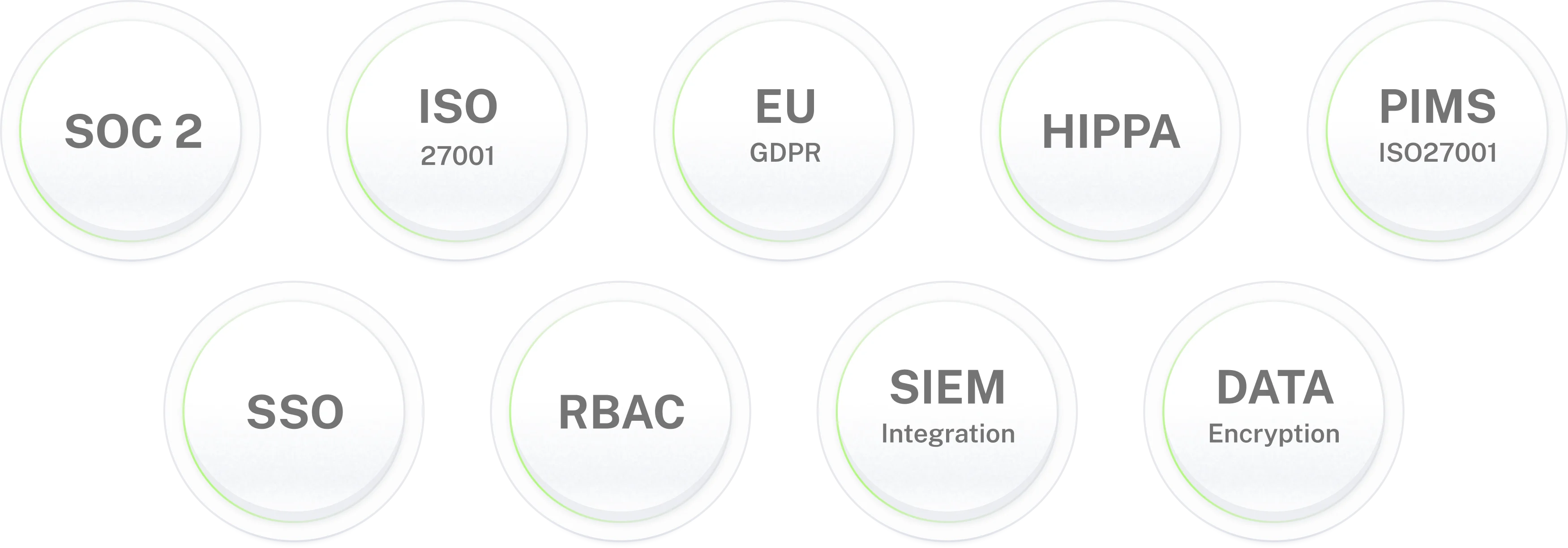
Enterprise-grade security. For HR data that matters.
Lucca AI agent
for your HR help desk.
80% of HR queries handled without HR involvement. Onboarding running from Lucca events.
Frequently asked questions
Lucca AI agent frequently asked questions
What is a Lucca AI agent?
A Lucca AI agent connects to your Lucca account and lets employees check leave balances, submit absence requests, access payslips, update personal details, and get HR policy answers all in Slack, without logging into Lucca. Lucca AI itself is an opt-in add-on that operates inside the Lucca platform. Workativ's Lucca AI agent takes action in Slack: it submits requests through Lucca's approval workflow, updates records, routes manager approvals, and coordinates connected systems like Okta and ServiceNow from a single Lucca trigger.
Does Lucca AI work in Slack or Microsoft Teams?
No. Lucca AI is an opt-in feature that operates inside the Lucca platform itself. Lucca's separate Slack and Teams integration, known as Lucca Office, syncs calendars and leave status showing who's out and updating Slack status automatically but does not let employees ask questions or take action from Slack. Workativ deploys a Lucca-connected AI agent natively in Slack that answers questions and submits requests, which neither Lucca AI nor Lucca Office currently does.
How is Workativ different from Lucca AI?
Lucca AI is an EU AI Act-compliant, opt-in add-on built into the Lucca platform for specific in-platform tasks. It does not extend into Slack, Teams, or systems outside Lucca. Workativ connects to Lucca's modules Figgo and Timmi Absences, Poplee, Pagga and brings the same self-service experience to Slack, plus extends action-taking into Okta, ServiceNow, and 100+ other apps that Lucca AI doesn't reach. Workativ and Lucca AI are complementary Lucca remains your system of record.
How does Workativ integrate with Lucca?
Workativ connects to Lucca via its public REST APIs including the Timmi Absences API for leave management using API key authentication and role-based access controls. Once connected, Workativ reads from Lucca modules like Figgo, Poplee, and Pagga, and writes back: submitting leave requests, updating personal details, and triggering onboarding workflows. No developer required.
Can the Lucca AI agent submit leave requests in Slack?
Yes. Employee asks in Slack. Workativ reads their live leave balance from Lucca's Figgo module via the Timmi Absences API, confirms availability, and submits the request through Lucca's approval workflow. Manager receives an approval card in Slack one tap to approve. Lucca record updated. Employee confirmed in the same thread. Lucca Office can sync the resulting leave status to Slack; Workativ submits the request itself and closes the loop.
What HR workflows can Workativ automate with Lucca?
Workativ automates three core Lucca workflows: new hire onboarding (a Poplee new hire event triggers Okta provisioning, an IT access ticket in ServiceNow or Jira, and a day-1 Slack checklist), leave approval (employee requests in Slack, manager approves in Slack, Figgo record updated), and offboarding (a Lucca termination event triggers Okta disable, Azure AD suspension, and an equipment return notification in Slack).
Is Workativ suitable for companies using Lucca across multiple countries?
Yes. Lucca is built for multi-country HR compliance, particularly French labor law, and serves over 7,800 clients across 130 countries. Workativ is GDPR compliant, ISO 27001 certified, and connects to Lucca without adding a separate compliance layer the AI agent respects the same country-specific leave policies and approval workflows already configured in Lucca.
Can the Lucca AI agent handle employee onboarding?
Yes. When a new hire is added in Poplee, Workativ triggers the full onboarding workflow: creates the Okta identity account with correct role and groups, raises an IT access ticket in ServiceNow or Jira, and delivers a day-1 checklist to the new hire in Slack before they start. Lucca remains the system of record. HR sets the workflow up once it runs for every new hire without manual steps.
Can employees update personal details in Lucca from Slack?
Yes. Employees update their address, emergency contacts, or bank details by asking in Slack. Workativ verifies their identity and writes the change directly to Lucca. No portal login. No HR ticket. Lucca record updated and confirmed in Slack.
Is Lucca employee data secure with Workativ?
Yes. Workativ connects to Lucca using API key authentication with role-based access controls. The AI agent only reads and writes what it has been explicitly permitted to access. Lucca data is never used to train models. PII is masked in all conversation logs. Every Lucca action is logged to an immutable audit trail. Workativ is SOC 2 Type II, ISO 27001, GDPR, and HIPAA compliant.
How long does Lucca AI agent deployment take?
3 to 5 days for standard HR self-service leave requests, pay queries, personal updates, HR policy Q&A. No developer required. No implementation project. Workativ's no-code platform connects Lucca, configures the AI agent, and deploys it to Slack. Most teams using Lucca configure and go live without involving IT.
Does Workativ replace Lucca AI?
No. Lucca AI remains useful for the in-platform tasks it was built for. Workativ extends the Lucca experience to Slack, where Lucca AI has no presence, and connects Lucca events to systems outside the platform Okta, ServiceNow, Azure AD, and more. The two run side by side, with Lucca staying your system of record.