

 HR Automation Software
HR automation that runs your processes not just assigns them to HR.
HR teams spend up to 57% of their time on administrative coordination that should run itself. Workativ's HR automation executes onboarding, offboarding, performance cycles, benefits enrollment, and compliance training end to end while keeping HR in the loop.
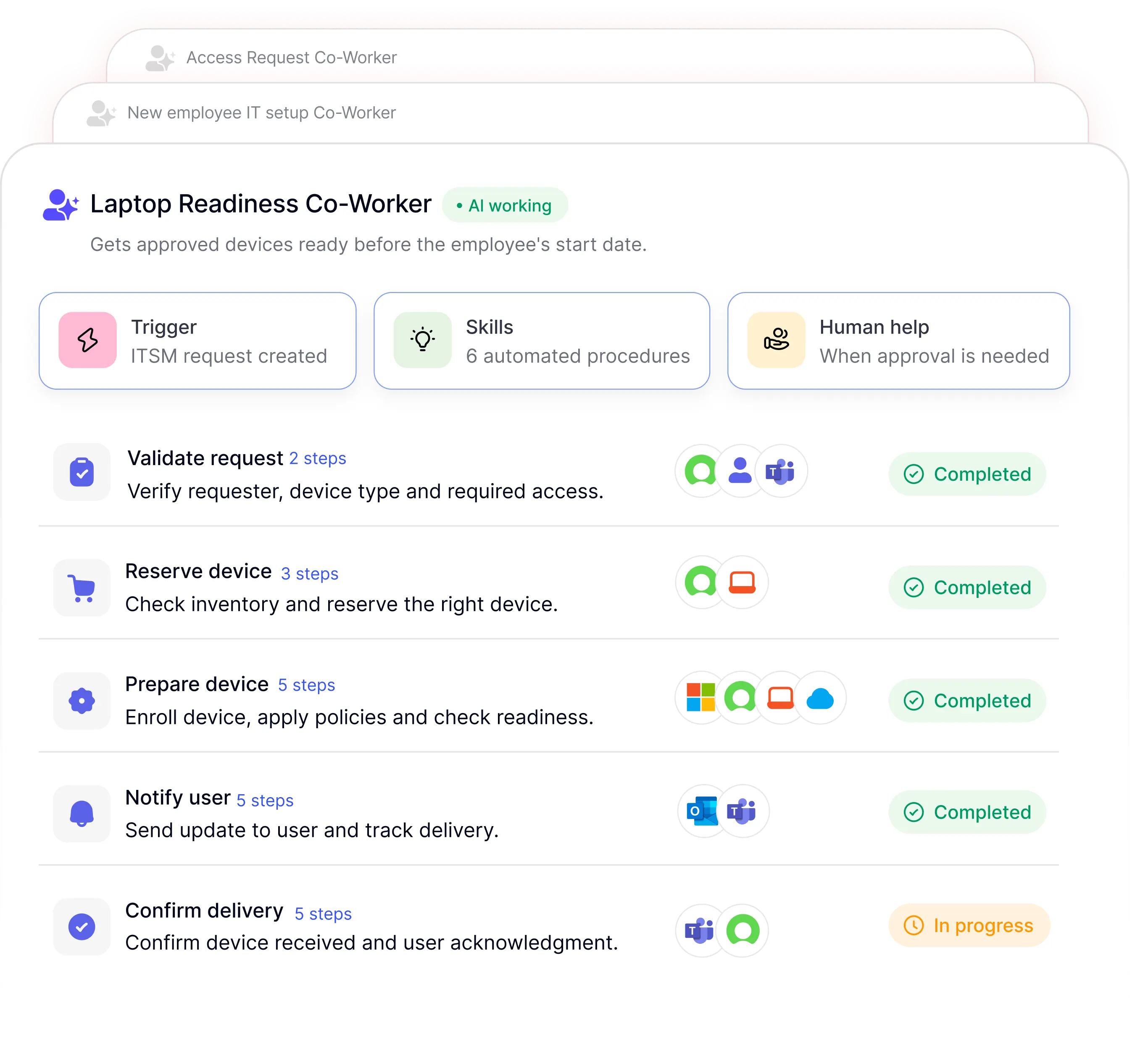
HR teams trust Workativ to automate HR processes end to end.

What is HR automation?
The definition and what separates task automation from true end-to-end HR workflow automation.
HR automation is the use of software to execute repetitive HR processes without manual coordination spanning the full employee lifecycle from onboarding through offboarding. HR process automation handles individual tasks. HR workflow automation goes further: it connects those tasks into end-to-end processes that execute across multiple systems without human handoffs. Modern HR automation software does not just send reminders it provisions accounts in Okta, routes approvals in Slack, updates your HRIS, assigns compliance training in your LMS, and tracks every step to completion.
Your HRIS creates the task. Workativ completes it.
Workday, UKG, ADP automates within their own systems. The moment a workflow crosses into Slack, Okta, Azure AD, or your LMS it stops. That is where Workativ begins.
Creates tasks.
Assigns them to HR.
New hire record created → checklist assigned to HR to complete manually
Onboarding logic is linear cannot branch by role, location, or department
Cannot trigger provisioning in Okta or Azure AD without middleware
Cannot send approval requests or notifications in Slack or Teams natively
Compliance tracking works within the HRIS cannot reach your LMS or cross state lines
Each step requires HR to manually move the process forward
Executes across systems. Tracks to completion.
New hire record created → Workativ provisions Okta, Azure AD, and Office 365 automatically
Conditional branching different onboarding paths by role, location, employment type
Triggers and executes across HRIS, identity, Slack, Teams, LMS, and payroll simultaneously
Approval requests and employee notifications delivered in Slack or Teams natively
Compliance tracking across systems, locations, and regulatory boundaries
Escalates exceptions automatically HR only sees what needs human judgment
Gap 1
Limited conditional
onboarding logic in your HRIS
HRIS onboarding is linear. Workativ branches automatically by role, location, department, and employment type so a remote engineer follows a different sequence than an in-office manager, without HR configuring it manually.
Gap 2
No native multi-
system trigger support
The moment an HR workflow needs to cross into Okta, Azure AD, Slack, or an LMS, your HRIS stops. Workativ connects and executes across all of them natively no middleware, no fragility, no IT dependency.
Gap 3
Compliance tracking
stops at system boundaries
HRIS compliance tracking works within the platform. Workativ assigns training, tracks completion across your LMS, and applies state and country-specific rules automatically regardless of where the employee sits.
Every HR process that should
run without your team coordinating it.
Each workflow is triggered by a system event, executed across connected systems, and tracked to completion with human-in-the-loop controls for steps that require HR judgment.

Employee onboarding automation
Trigger → New hire record in HRIS
IT provisioning, document signing, benefits enrollment, manager introductions, compliance training, Slack notifications triggered on offer acceptance, executed across systems, tracked to Day 30.


Employee offboarding automation
Trigger → Termination date in HRIS
Access revoked across Okta, Azure AD, and Office 365 simultaneously. Equipment return initiated. Exit interview scheduled. Final documentation completed. No orphaned accounts.


Performance review automation
Trigger → Review date reached
Self-assessment notifications, manager review deadlines, calibration scheduling, completion tracking, and escalations for anything overdue the full performance review automation cycle runs without HR chasing.


30/60/90 day check-in automation
Trigger → 30, 60, 90 day milestone
Survey distributed automatically at each milestone. Responses collected and sentiment analysed. Retention risk flagged to HR for human review. Runs consistently for every new hire.


Benefits enrollment automation
Trigger → Enrollment window opens
Benefits enrollment automation handles real-time Q&A during open enrollment, sends deadline reminders automatically, and flags non-completions to HR. Zero manual chasing during your highest-volume period.


Compliance training automation
Trigger → Compliance deadline approaching
Compliance training automation assigns training by role, location, and regulatory requirement automatically. Progressive reminders sent in Slack. Manager escalation triggered for non-completions. Audit-ready completion report generated.

What HR workflow automation returns to your team.
Based on GoTo's workflow analysis 7,179 annual HR tickets mapped to Workativ automation scope across AI workflows and AI agent actions.
Hours returned to
HR mid-point
estimate 897hrs/mo
At a mid-point automation assumption across all in-scope workflows, Workativ returns approximately 897 HR hours per month equivalent to over 10,700 hours annually redirected from repetitive coordination to strategic HR work.
What those hours
were spent on
43Khrs/yr
GoTo's 7,179 annual in-scope HR tickets each carried an average of 6 active handling hours 43,074 hours annually spent on manual routing, follow-ups, status checks, and coordination that Workativ now executes automatically.
AI workflow tickets (structured processes)
AI agent tickets (knowledge + actions)
Total in-scope annual volume

Susan Treadway
Vice President, HR Operations

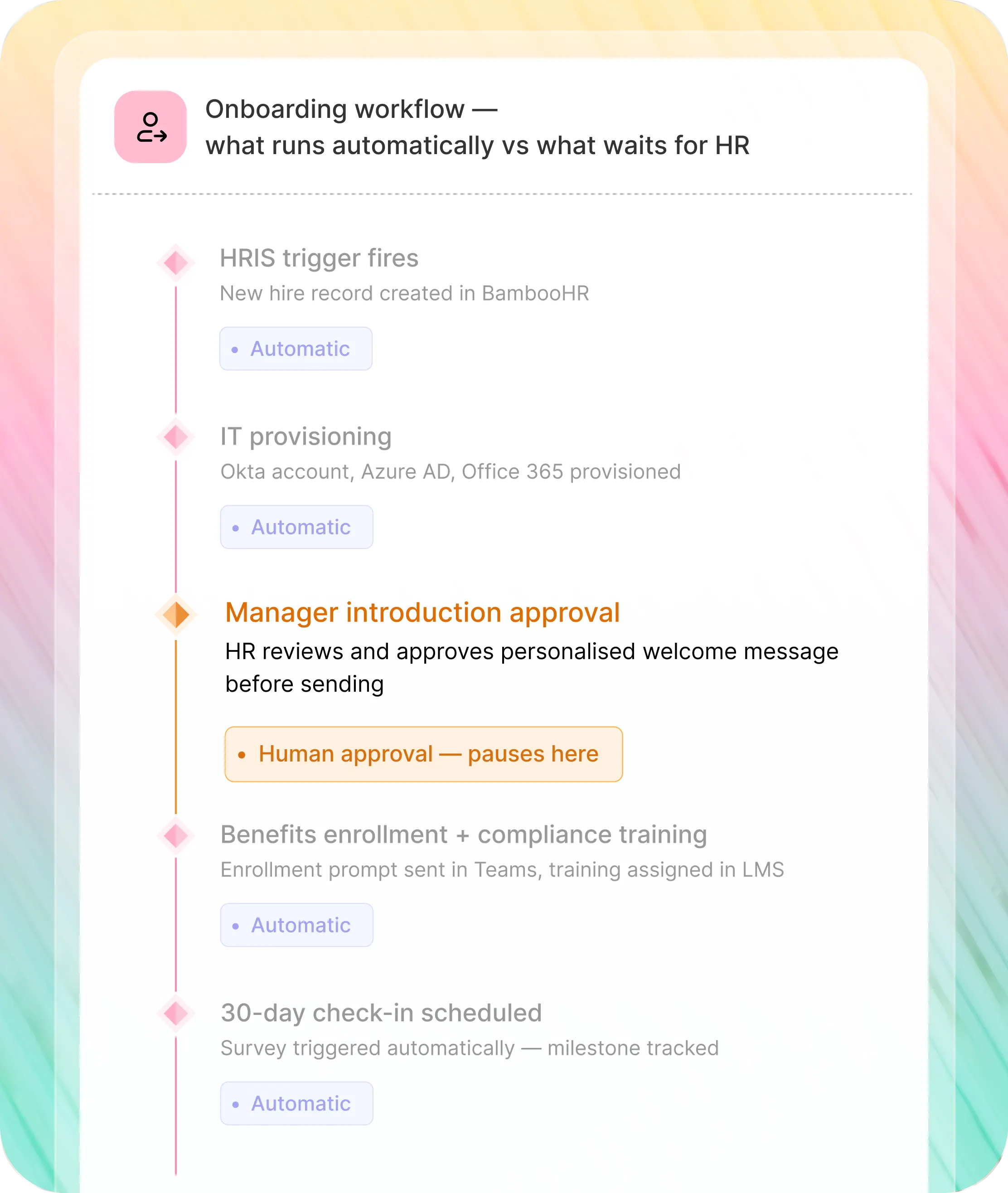
Automation runs the process. HR approves what requires judgment.
Not every step in an HR workflow should be fully automated. Workativ lets HR teams define exactly which steps pause for approval before continuing and escalates automatically if no response is received.
Define approval gates per workflow.
Configure which steps require HR or manager sign-off before the workflow continues. Everything outside those gates runs automatically.
Auto-escalation on non-response.
If an approver does not respond within your defined window, the workflow escalates to the next person in the chain — no manual follow-up required.
Full audit trail on every step.
Every automated action, every approval, and every escalation is logged with a timestamp — compliance-ready from day one.
HR automation that executes where your data and people actually live.
100+ pre-built integrations. Bidirectional read and write Workativ executes actions in your systems, not just lookups.


'/%3e%3cpath%20d='M7.53747%209.7499L4.18595%209.72912C3.89511%209.72912%203.66314%209.49022%203.66314%209.20285C3.66314%209.08859%203.70122%208.98126%203.76701%208.89124L8.69389%202.30244C10.2589%203.46925%2010.5809%205.68513%209.41059%207.2501L7.53747%209.7499Z'%20fill='url(%23paint1_linear_217_318)'/%3e%3cdefs%3e%3clinearGradient%20id='paint0_linear_217_318'%20x1='7.3717'%20y1='1.41211'%20x2='9.07645'%20y2='11.0799'%20gradientUnits='userSpaceOnUse'%3e%3cstop%20stop-color='%239DC9FC'/%3e%3cstop%20offset='0.6866'%20stop-color='white'/%3e%3c/linearGradient%3e%3clinearGradient%20id='paint1_linear_217_318'%20x1='9.68512'%20y1='1.62241'%20x2='6.91576'%20y2='7.45173'%20gradientUnits='userSpaceOnUse'%3e%3cstop%20stop-color='%239DC9FC'/%3e%3cstop%20offset='0.7152'%20stop-color='white'/%3e%3c/linearGradient%3e%3c/defs%3e%3c/svg%3e)


%20--%3e%3csvg%20version='1.1'%20id='Layer_1'%20xmlns='http://www.w3.org/2000/svg'%20xmlns:xlink='http://www.w3.org/1999/xlink'%20x='0px'%20y='0px'%20viewBox='0%200%20512%20512'%20style='enable-background:new%200%200%20512%20512;'%20xml:space='preserve'%3e%3cstyle%20type='text/css'%3e%20.st0{fill:%23F7F7F7;}%20.st1{fill:%2328E4C3;}%20.st2{fill:url(%23SVGID_1_);}%20.st3{fill:url(%23SVGID_2_);}%20%3c/style%3e%3ccircle%20class='st0'%20cx='256'%20cy='256'%20r='245.5'/%3e%3cg%3e%3cg%3e%3cpath%20class='st1'%20d='M304.7,405.6'/%3e%3c/g%3e%3c/g%3e%3cg%3e%3cg%3e%3cpath%20class='st1'%20d='M305.8,353'/%3e%3c/g%3e%3c/g%3e%3clinearGradient%20id='SVGID_1_'%20gradientUnits='userSpaceOnUse'%20x1='388.1461'%20y1='99.0534'%20x2='204.4846'%20y2='204.5899'%20gradientTransform='matrix(1%200%200%20-1%200%20514)'%3e%3cstop%20offset='0.18'%20style='stop-color:%230052CC'/%3e%3cstop%20offset='1'%20style='stop-color:%232684FF'/%3e%3c/linearGradient%3e%3cpath%20class='st2'%20d='M119.9,330.3c-3,4.9-6.4,10.7-9.3,15.3c-2.6,4.4-1.2,10,3.1,12.7l60.7,37.4c4.4,2.7,10.1,1.3,12.9-3%20c0,0,0.1-0.1,0.1-0.1c2.4-4.1,5.6-9.3,9-15c24-39.7,48.2-34.8,91.9-14l60.2,28.6c4.7,2.2,10.2,0.2,12.4-4.4c0-0.1,0.1-0.2,0.1-0.3%20l28.9-65.4c2-4.7,0-10.1-4.7-12.2c-12.7-6-38-17.9-60.7-28.9C242.6,241.2,173.1,243.7,119.9,330.3z'/%3e%3clinearGradient%20id='SVGID_2_'%20gradientUnits='userSpaceOnUse'%20x1='613.0198'%20y1='1773.9866'%20x2='429.3116'%20y2='1879.5697'%20gradientTransform='matrix(-1%200%200%201%20736.83%20-1676.71)'%3e%3cstop%20offset='0.18'%20style='stop-color:%230052CC'/%3e%3cstop%20offset='1'%20style='stop-color:%232684FF'/%3e%3c/linearGradient%3e%3cpath%20class='st3'%20d='M392.1,181.9c3-4.9,6.4-10.7,9.3-15.3c2.6-4.4,1.2-10-3.1-12.7l-60.7-37.4c-4.3-2.9-10.1-1.7-13,2.5%20c-0.1,0.2-0.2,0.4-0.3,0.6c-2.4,4.1-5.6,9.3-9,15c-24,39.7-48.2,34.8-91.9,14l-60-28.5c-4.7-2.2-10.2-0.2-12.4,4.4%20c0,0.1-0.1,0.2-0.1,0.3L122,190.2c-2,4.7,0,10.1,4.7,12.2c12.7,6,38,17.9,60.7,28.9C269.4,271,338.9,268.4,392.1,181.9z'/%3e%3c/svg%3e)


%20--%3e%3csvg%20version='1.1'%20id='Layer_1'%20xmlns='http://www.w3.org/2000/svg'%20xmlns:xlink='http://www.w3.org/1999/xlink'%20x='0px'%20y='0px'%20viewBox='0%200%20512%20512'%20style='enable-background:new%200%200%20512%20512;'%20xml:space='preserve'%3e%3cstyle%20type='text/css'%3e%20.st0{fill:%23EB3C00;}%20.st1{fill:%23FFFFFF;}%20%3c/style%3e%3ccircle%20class='st0'%20cx='256'%20cy='256'%20r='245.5'/%3e%3cpath%20class='st1'%20d='M152.2,332.7v-152L286.7,131l73.1,23.4V359l-73.1,22L152.2,332.7l134.4,16.2V171.9L199,192.4v119.8L152.2,332.7%20z'/%3e%3c/svg%3e)

'%3e%3cpath%20d='M1.86774%200H2.41284C2.55325%200.0357914%202.8438%200.0814543%202.96023%200.144319C3.57556%200.476574%204.24389%200.994086%204.78094%201.44029C4.90785%201.49857%205.14031%201.69076%205.26616%201.78501L6.30254%202.56565L9.23874%204.76784L9.98605%205.32579C10.1165%205.42327%2010.3896%205.61784%2010.4874%205.73305C10.5933%205.62723%2010.7819%205.49083%2010.9035%205.39513C11.2293%205.13895%2011.5711%204.89897%2011.9015%204.64888L14.841%202.43616C15.2641%202.11793%2015.808%201.74101%2016.2059%201.4114C16.7548%201.01773%2017.2984%200.503308%2017.8952%200.193124C18.0888%200.0925009%2018.3311%200.0707975%2018.4996%200.00453492L18.511%200H19.1089C19.2716%200.0419345%2019.4446%200.0664859%2019.6017%200.126337C20.3949%200.428494%2020.8251%201.03647%2020.9795%201.84719V4.05546L17.6977%206.51872L16.7256%207.24655C16.6175%207.32813%2016.3229%207.56223%2016.2176%207.62326L16.2116%207.64067C16.0556%207.74125%2015.7554%207.98423%2015.5914%208.10717L14.2347%209.12565C12.9949%2010.0567%2011.7226%2010.9908%2010.4942%2011.9326C10.3311%2011.8196%2010.1521%2011.6753%209.99028%2011.5543L8.91562%2010.7499L6.14505%208.67116C5.6887%208.32244%205.22946%207.97753%204.76737%207.63644L4.76105%207.62385C4.64747%207.54843%204.4662%207.40207%204.35254%207.31617L3.58531%206.74057L0.993507%204.79937C0.666643%204.55579%200.329975%204.28777%200%204.0539V1.89895C0.0211067%201.8406%200.034732%201.7287%200.0477586%201.66355C0.195443%200.924862%200.778193%200.297181%201.50398%200.095359C1.61897%200.0633797%201.74239%200.0411929%201.85419%200.00451034L1.86774%200Z'%20fill='%23EB4337'/%3e%3cpath%20d='M18.5112%200H19.109C19.2718%200.0419345%2019.4448%200.0664859%2019.6018%200.126337C20.395%200.428494%2020.8252%201.03647%2020.9797%201.8472V4.05546L17.6978%206.51872L16.7258%207.24655C16.6176%207.32813%2016.3231%207.56223%2016.2177%207.62326C16.2065%207.10816%2016.2151%206.56484%2016.215%206.04638L16.2148%203.13227L16.2154%201.98927C16.2154%201.85241%2016.2236%201.52684%2016.2061%201.4114C16.755%201.01773%2017.2986%200.503308%2017.8953%200.193124C18.089%200.0925009%2018.3312%200.0707975%2018.4998%200.00453492L18.5112%200Z'%20fill='%23FCBC03'/%3e%3cpath%20d='M1.86774%200H2.41284C2.55325%200.0357914%202.8438%200.0814543%202.96023%200.144319C3.57556%200.476574%204.24389%200.994086%204.78094%201.44029C4.75802%201.55136%204.76536%201.81314%204.76577%201.93571L4.7683%202.76769L4.76727%206.06197L4.76854%207.06889C4.76879%207.22294%204.77708%207.48131%204.76105%207.62385C4.64746%207.54843%204.4662%207.40207%204.35254%207.31617L3.58531%206.74057L0.993506%204.79937C0.666643%204.5558%200.329975%204.28777%200%204.0539V1.89895C0.0211067%201.8406%200.034732%201.7287%200.0477586%201.66355C0.195443%200.924862%200.778193%200.297181%201.50398%200.095359C1.61897%200.0633798%201.74239%200.0411929%201.85419%200.00451034L1.86774%200Z'%20fill='%23C62220'/%3e%3cpath%20d='M0%204.05371C0.329975%204.28758%200.666643%204.5556%200.993507%204.79918L3.58531%206.74038L4.35254%207.31598C4.4662%207.40188%204.64747%207.54824%204.76105%207.62365L4.76737%207.63625C4.79294%207.81891%204.78411%208.19988%204.78406%208.39833L4.78312%209.71796L4.78339%2014.2476C4.7834%2014.4489%204.8101%2015.6601%204.76016%2015.7263C4.75851%2015.7284%204.75656%2015.7304%204.75498%2015.7326C4.75244%2015.7361%204.75024%2015.74%204.74778%2015.7435C4.7463%2015.7457%204.74469%2015.7477%204.74315%2015.7498H1.23433C1.02953%2015.6658%200.870008%2015.6564%200.656526%2015.5145C0.258114%2015.2497%200.102217%2014.9456%200%2014.4978V4.05371Z'%20fill='%234185F5'/%3e%3cpath%20d='M20.9794%204.05566V14.5025C20.828%2015.1172%2020.5387%2015.5356%2019.8875%2015.6981C19.8377%2015.7104%2019.7443%2015.7302%2019.7008%2015.7502H16.235C16.1758%2015.6436%2016.1987%2013.9178%2016.1987%2013.683L16.199%2010.2145L16.1984%208.51668C16.1982%208.31838%2016.1872%207.81396%2016.2115%207.64088L16.2175%207.62347C16.3228%207.56244%2016.6174%207.32834%2016.7255%207.24676L17.6976%206.51892L20.9794%204.05566Z'%20fill='%2333A953'/%3e%3c/g%3e%3cdefs%3e%3cclipPath%20id='clip0_1380_1288'%3e%3crect%20width='20.9795'%20height='15.75'%20fill='white'/%3e%3c/clipPath%3e%3c/defs%3e%3c/svg%3e)
%20--%3e%3csvg%20version='1.1'%20id='Layer_1'%20xmlns='http://www.w3.org/2000/svg'%20xmlns:xlink='http://www.w3.org/1999/xlink'%20x='0px'%20y='0px'%20viewBox='0%200%20512%20512'%20style='enable-background:new%200%200%20512%20512;'%20xml:space='preserve'%3e%3cstyle%20type='text/css'%3e%20.st0{fill:%230062FF;}%20.st1{fill:%23FFFFFF;}%20%3c/style%3e%3ccircle%20class='st0'%20cx='256'%20cy='256'%20r='245.5'/%3e%3cpath%20class='st1'%20d='M256,162.5l-91,58.2l91,58.2l-91,58.2l-91-59.1l91-58.2l-91-57.3l91-58.2L256,162.5z%20M164.1,355.5l91-58.2%20l91,58.2l-91,58.2L164.1,355.5z%20M256,278.1l91-58.2l-91-57.3l91-58.2l91,58.2l-91,58.2l91,58.2l-91,58.2L256,278.1z'/%3e%3c/svg%3e)


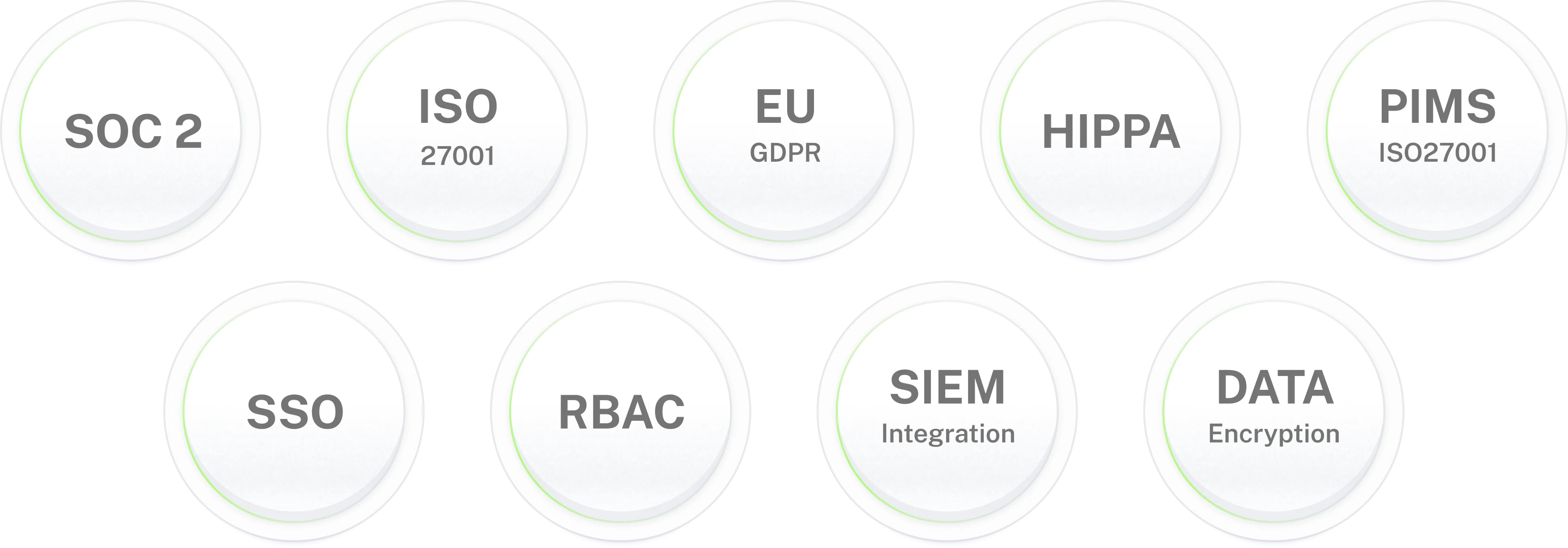
HR automation with a full audit trail on every step, every time.
Ready to stop coordinating HR
workflows manually?
Deploy HR automation that executes end to end in 5 to 7 days, with your team or ours.
Frequently asked questions
Questions HR Directors, People Ops leaders, and CHROs ask about Workativ's HR chatbot.
What is HR automation?
HR automation is the use of software to execute repetitive HR processes without manual coordination. It spans the full employee lifecycle: onboarding new hires, managing leave, running performance cycles, tracking compliance training, and offboarding departing employees. Modern HR automation uses AI to trigger workflows from system events, execute steps across multiple connected systems, and handle exceptions without HR intervention.
What is HR workflow automation?
HR workflow automation connects individual HR tasks into structured, end-to-end processes that execute across multiple connected systems without human handoffs at each step. Rather than automating a single task, HR workflow automation orchestrates the full sequence HRIS trigger fires, Okta provisioned, Slack notification sent, LMS training assigned, check-in scheduled all without HR manually moving each step forward.
How is HR automation different from what my HRIS already does?
An HRIS like BambooHR or Workday creates tasks and assigns them to HR it stores data and initiates checklists within its own system. HR automation executes across system boundaries: it provisions access in Okta, sends approvals in Slack, updates records in BambooHR, assigns training in your LMS, and tracks completion without HR manually moving each step. The HRIS is the system of record. Workativ is the automation layer that acts on it.
What HR workflows can Workativ automate?
Workativ automates employee onboarding triggered from new hire HRIS records, employee offboarding triggered from termination events, 30/60/90 day check-ins, performance review cycles, benefits enrollment, compliance training tracking, and leave management. Each workflow is triggered automatically from system events and executed across all connected systems without HR manual coordination.
What triggers HR automation workflows in Workativ?
Workativ workflows are triggered by system events a new hire record created in BambooHR, a termination date set in Workday, a review period reached, a form submitted by an employee, or a compliance deadline approaching. Triggers can also be manual for workflows where HR needs to initiate the process. Once triggered, the workflow runs end to end without further manual coordination.
Does HR automation replace HR staff?
No. HR automation returns time to HR staff by eliminating repetitive coordination, manual follow-up, and status tracking. GoTo returned 897 HR hours per month using Workativ that capacity was redirected to strategic HR work. Human-in-the-loop controls ensure HR approves steps that require judgment before the workflow continues. The value is capacity returned, not headcount reduced.
What is human-in-the-loop HR automation?
Human-in-the-loop HR automation allows HR teams to define which workflow steps require human approval before continuing. For example, an offboarding workflow might execute access revocation automatically but pause for an HR manager to approve the final separation document before sending. If no approval is received within a defined window, the workflow auto-escalates. Everything outside defined approval gates runs automatically.
Why does HRIS automation fall short for end-to-end HR processes?
Three gaps consistently drive HR teams to add a dedicated automation layer: limited conditional onboarding logic that cannot branch based on role, location, or department; no native multi-system trigger support the moment a workflow needs to cross into Okta, Azure AD, Slack, or an LMS, the HRIS stops and requires middleware; and inability to automate compliance tracking across state or country lines without manual rule configuration.
How long does it take to deploy HR automation with Workativ?
Workativ deploys in 5 to 7 days for a typical mid-market HR team. Pre-built connectors for BambooHR, Workday, ADP, UKG, Okta, Azure AD, Slack, and Microsoft Teams mean no custom integration work. Pre-built workflow templates for onboarding, offboarding, performance cycles, and compliance training are configurable without developer involvement.
What is the ROI of HR workflow automation?
GoTo modelled 7,179 annual HR tickets in scope for Workativ automation 1,748 structured workflow tickets and 5,431 AI agent knowledge and action tickets. At a mid-point automation assumption, Workativ returned approximately 897 HR hours per month over 10,700 hours annually redirected from repetitive coordination to strategic HR work.
What systems does Workativ connect to for HR automation?
Workativ connects to BambooHR, Workday, ADP, UKG, Rippling, HiBob, Personio, SAP SuccessFactors, Oracle HCM, Okta, Azure AD, Office 365, Slack, Microsoft Teams, SharePoint, Confluence, Google Drive, ServiceNow, Jira Service Management, and 100+ other tools. All integrations support bidirectional read and write Workativ executes actions in your systems, not just lookups.
Is Workativ HR automation secure for sensitive employee data?
Yes. Workativ is SOC 2 Type II, ISO 27001, GDPR, and HIPAA compliant. HR workflow automation includes role-based access controls ensuring workflows only access data within defined permissions, PII data redaction for sensitive employee information, a full immutable audit trail of every automated action, and human-in-the-loop controls for steps requiring HR approval.